Showing posts with label soccer. Show all posts

Thursday, May 7, 2009

Following a Minority Sport in NYC

This article first appeared in Aberdeen Football Club's RedMatchday Magazine on May 2, 2009.

Football may be viewed as a minority sport in the U.S., but in a city as multicultural and monolithic as New York there are hundreds of thousands of soccer fans following the action from Europe and South America every week. The problem for Major League Soccer is getting those fans through the gates at New York Red Bulls matches.

The Red Bulls struggle to attract more than 15,000 fans to their home games despite inhabiting a greater metropolitan area of some 19 million people. It is a mark they achieved only six times in 16 fixtures last season. Arena location does not help. Giants Stadium, the current abode shared with the NFL’s Giants and Jets, was built across the Hudson River on the swampy wastelands of East Rutherford, New Jersey. Though only seven miles from Midtown Manhattan, the venue poses transportation challenges for many of the city’s vehicle-less residents…and tourists. Sacrifices are easily made to watch the NFL, but not MLS. Not yet.

Unperturbed, I made the journey a fortnight ago to see the Red Bulls clinch an unflattering 2-0 win over Real Salt Lake—their first victory of the season. I wondered how many others would join me.

I set off from my hotel at 5.15, travel instructions printed from the Red Bulls’ website in hand, allowing plenty of time for a 7.30 kick-off. Steps One and Two were a breeze as I strolled the three blocks to Penn Station and acquired a special $10 roundtrip ticket covering the train and bus rides to the stadium. By contrast, residents of Bronx, Brooklyn, or Queens firstly have to negotiate the city’s extensive transport network to arrive at Manhattan’s major rail hub. But there I was, ticket at the ready, scanning the departures board at 5.29, when major inconvenience reared its head.

Step Three involved taking a New Jersey-bound train to nearby Secaucus Junction. Plenty of trains cross under the river, but only one every hour was identified as stopping at Secaucus. With 42 minutes to fill until the 6.11 to Dover, I wandered the station concourse looking for gathering throngs of exuberant soccer followers heading to the match. None appeared. Instead, the platforms overflowed with New York Mets merchandise as fans returned home from an afternoon watching baseball at Citi Field.

I finally arrived at Secaucus station at 6.20 and embarked upon Stage Four—transferring to one of the buses heading for Giants Stadium. Within ten minutes Stage Five was complete as I alighted in a vast but desolate parking lot. Americans love to tailgate, but I could see no more than a dozen people enjoying a pre-game beer before entering the stadium confines.

Ticket prices are an appealing feature of MLS. I snapped up an excellent seat between the 18-yard and halfway lines—only ten rows from the front—for a mere $32 and settled down to see if Salt Lake could avenge their defeat in last season’s Western Conference Final.

Instead it took the hosts less than 100 seconds to go ahead. Nick Rimando could only parry a cross from Dane Richards and Senegalese striker Macoumba Kandji was on hand to thump the loose ball high beyond the prostrate goalkeeper.

The goal arrived too soon for many in attendance, including the stadium announcer who credited the goal to Richards. Even legendary English commentator John Motson would struggle to confuse this pair given that, at 6”4”, Kandji towers over his diminutive teammate by almost an entire foot.

As regular attendees will testify, there is a level of banter among football crowds which cannot be rivalled at any other sporting event. Not only has this humour survived the gentrification of many stadia—albeit in a watered-down format—but it exists in whichever country you watch the game. The U.S. is no different.

One typically brash New Yorker behind me filled the role of sarcastic, infuriated fan admirably, berating his team to the extent that his larynx risked permanent damage. His shouts increased in frequency and volume after half-time when left-midfielder Khano Smith switched to our side of the field.

Smith, signed from New England in the close season to replace departed Dutchman Dave van den Bergh, has a long way to go to win over the Red Bulls’ support. His every contribution or lack thereof provoked taunts from Mr Infuriated Fan, who questioned everything from Smith’s work ethic to his parentage.

The pessimistic support poured further scorn on their team as Salt Lake seemed primed for an equaliser, with one victim known as “Deadweight” serving as another prime target. The inevitable equaliser looked to have arrived when Yura Movsisyan’s deflected effort looped over Red Bulls’ goalkeeper John Conway toward an empty net, but defender Kevin Goldthwaite raced back to clear acrobatically from his goal-line. My question had been answered.

“Hey, it’s Deadweight!” roared one fan as ironic cheers and chuckles engulfed the disbelieving section.

A moment of brilliance from Kandji on 57 minutes set up Juan Pablo Angel to give New York a two-goal cushion. It was a deficit that Salt Lake failed to reduce despite the 66th minute dismissal of Red Bulls’ defender Jeremy Hall.

By 9.40, five minutes after the full-time whistle, I was back on the shuttle bus to Secaucus, arriving at 10.00 for the 10.20 train back to Penn Station. The slight delay caused my nostrils to fill with the putrid smell of the surrounding swamps as celebratory Red Bulls fans were joined by young revellers seeking the excitement and bright lights of a Saturday night in the Big Apple.

Overall, my journey had been seamlessly convenient. Then I learned that the attendance had been abysmally low—only 8,508 for New York’s second home game of the season. Queuing for trains and buses would be an altogether more unpleasant experience if joined by another 30,000 fans.

For now, following a “minority sport” does have its advantages.

Tuesday, March 17, 2009

MLS 2009 Preview

Predicting the Major League Soccer champions days before the new season begins is an unenviable task.
Firstly, strict roster restrictions and salary caps guarantee a certain level of parity among the league’s 15 franchises.

Secondly, huge uncertainty exists around which players will be available for the entire campaign—flourishing performances can attract summer transfers to Europe, while American expatriates failing to make the grade abroad or nearing the end of their careers may be making the opposite journey.

Thirdly, MLS does not adjourn for international dates—this is especially relevant in 2009 with ongoing World Cup qualification and the CONCACAF Gold Cup tournament taking place, as well as the U.S. team’s participation in June’s Confederations Cup.

Finally, as New York Red Bulls showed last year, anything can happen when it comes to the post-season play-offs.

Columbus Crew suffered three seasons of purgatory before rebounding to the top of the regular season table and lifting MLS Cup last year. Real Salt Lake fell agonisingly short of appearing in that final having also turned around three seasons of woe to mount a title challenge.

In this year’s Western Conference, I’m going for seasoned campaigners Houston Dynamo to reclaim their crown with Real Salt Lake as their closest challengers. In the East, another Conference Final between Columbus Crew and Chicago Fire could be on the cards but with a different outcome.

Come November 22 at Seattle’s Qwest Field, I’ll take Houston to clinch their third MLS Cup in four seasons over Cuauhtemoc Blanco and his Chicago teammates.

Here is a look at this year’s title contenders, play-off hopefuls, and helpless stragglers.

The Contenders

Chicago Fire (2008—3rd overall in regular season, lost to Columbus Crew in Eastern Conference final)

Head coach Denis Hamlett retains much of the squad that pushed Columbus all the way to the Eastern Conference title last year.

Cuauhtémoc Blanco, the team’s fiery 36-year-old Mexican captain, may be in the twilight months of his career, but he continues to inspire his teammates—particularly the impressive American forward Chris Rolfe.

Brian McBride, another 36-year-old veteran, adds his experience for a full campaign after arriving midway through last year to notch five goals in 11 games.

Former Manchester United trainee John Thorrington will be a major threat from midfield if he can remain injury-free.

This year could be MLS Cup or bust for Hamlett’s ageing stars.

Columbus Crew (2008—1st overall, MLS Cup Winners)

The champions’ title defence kicks off with much the same squad as last year despite fears that 35-year-old Argentine playmaker Guillermo Barros Schelotto, last season’s league and MLS Cup Most Valuable Player, may not return.

Schelotto is again supported by the highly-rated young winger Robbie Rogers and Venezuelan striker Alejandro Moreno.

Head coach Sigi Schmid’s defection to Seattle Sounders is a huge loss. Former Everton striker Robert Warzycha, who ended his playing days with Columbus, steps in to fill the void.

The Crew will remain near the Eastern Conference summit, but an expanded schedule with Champions League commitments will severely test their squad.

Houston Dynamo (2008—2nd overall, lost to New York Red Bulls in Western Conference semi-final)

The 2006 and 2007 champions were arguably the league’s best team last year, but they were undone by the most congested schedule in the league (participating in the Pan-Pacific Championship, CONCACAF Champions Cup, US Open Cup, Superliga, and CONCACAF Champions League) as well as the eminent fortune of New York’s post-season run.

Star player Dwayne De Rosario returned home to Toronto in the off-season, but his departure presents an opportunity for Aberdeen-born attacking midfielder Stuart Holden to cement his first team place. The Dynamo midfield remains formidable with Brad Davis, Ricardo Clark, Geoff Cameron, and Brian Mullan all capable of making strong contributions.

Houston’s defence has already been cruelly exposed by Atlante in the Champions League quarter-final, and the news that Eddie Robinson will likely miss the entire season is a devastating blow. Julius James arrives as part of the De Rosario trade but he will take time to settle into new surroundings.

Head coach Dominic Kinnear, however, is a master of strengthening his squad in the summer. His team remains serious title contenders. They have the experience and hunger to reclaim the title.

Los Angeles Galaxy (2008—13th overall)

No team finished 2008 with fewer points than the league’s self-appointed flagship franchise, leaving Bruce Arena with a major rebuilding job over the winter.

The former U.S. national team manager has overhauled his defence. Steve Cronin, Ante Jazic, Mike Randolph, Troy Roberts, and Greg Vanney have all being shipped out. Of that calamitous group, only Jazic remains in the league at present (with Chivas USA). Ukrainian Dema Kovalenko comes in from Real Salt Lake to fortify the midfield.

Landon Donovan returns from Bayern Munich to link up rejoin Edson Buddle in attack—a lethal partnership that netted 35 times for the league’s most potent offense last year.

Arena will definitely solidify this team and should have them mounting a challenge for the first time since 2005, but as always the key figure will be Galaxy’s English Tourist even though he misses the first four months due to more pressing commitments elsewhere.

Since Beckham’s MLS debut in August 2007, the team has accumulated 30 points from 30 games in his presence (33%). Galaxy performs markedly better in his absence—23 points from 17 games (45%).

Success or failure may hinge on whether Arena continues to hold the reigns when Beckham returns from his increasingly mediocre loan to Milan, or whether the club’s management will again be undermined by pop svengali Simon Fuller.

Real Salt Lake (2008—7th overall, lost to New York Red Bulls in Western Conference final)

Jason Kreis’ team were the form side toward the end of last season, with only the width of the Rio Tinto Stadium goal frame preventing them from reaching MLS Cup Final.

Kreis has built a solid squad around core team values—there are no high earners on this roster, but there is quality.

The departures of Dema Kovalenko, Fabian Espindola, and Kenny Deuchar frees up salary cap room should Kreis need to reinforce his squad in the summer.

Look for Kyle Beckerman, Javier Morales, and Yura Movsisyan to fire this team back into the play-offs.

Play-Off Hopefuls

Chivas USA (2008—5th overall, beaten by Real Salt Lake in Western Conference semi-final)

No team has endured greater misfortune with injuries in recent seasons, as exemplified by the signing of Swiss international Raphael Wicky. The former Hamburg midfielder was limited to 138 minutes of action last year before picking up an ankle injury which has subsequently led to his retirement.

Head coach Preki also loses the experience of veteran Mexican defender Claudio Suarez to retirement. Francisco Mendoza, another Mexican, returns south of the border to Chivas de Guadalajara.

With no major signings, much will depend on the health of forwards Ante Razov and Maykel Galindo. After contributing 23 goals between them in 2007, injuries restricted the pair to a combined 22 starts and 6 goals last year.

A question remark hovers over the future of midfielder Sacha Kljestan. The U.S. international trained with Celtic in January and remains on the radar of European clubs. Impressive displays in either the Confederations Cup or Gold Cup could see him depart in the summer.

Expect Chivas to reach the play-offs again, but no more.

D.C. United (2008—10th overall)

The most decorated franchise in MLS history suffered a dreadful campaign in 2008, missing out on the play-offs after two successive years of winning the Supporters’ Shield.

Some pride was restored by lifting the U.S. Open Cup, but head coach Tom Soehn knows that vast improvement in the league is essential to keep the pressure off his shoulders.

Argentine midfielder Christian Gomez returns to the capital after one season with Colorado Rapids. He replaces his countryman Marcelo Gallardo who has returned to River Plate after a disappointing campaign as D.C.’s designated player.

Brazilian striker Luciano Emilio and veteran Bolivian playmaker Jaime Moreno continue to carry the attacking threat.

United will improve this season, but not enough to pose a genuine title threat.

New England Revolution (2008—4th overall, lost to Chicago Fire in Eastern Conference semi-final)

The Revs were another team who stagnated last year as a result of injuries to key players.

After three successive MLS Cup Final defeats from 2005 to 2007, Steve Nicol’s team exited tamely against Chicago in last year’s Eastern Conference semi-final.

Taylor Twellman, one of the league’s top strikers, missed half of last year through injury. His health is vital to New England’s success, especially with his understudy Adam Cristman moving on to Kansas City Wizards.

Shalrie Joseph and Steve Ralston remain as the driving forces in midfield, while much will depend on the continued development of Gambian youngsters Kenny Mansally and Sainey Nyassi.

The loss of defender Michael Parkhurst to Danish Superliga outfit FC Nordsjælland is a significant loss at the back.

Another Conference semi-final exit could be on the cards.

New York Red Bull (2008—8th overall, lost to Columbus Crew in MLS Cup Final)

Mired in mediocrity for the entire 2008 regular season, the Red Bulls somehow summoned the spirit—and generous doses of luck—to reach MLS Cup Final having overcome both Houston Dynamo and Real Salt Lake on the road.

Head coach Juan Carlos Osorio is a shrewd tactician with a peripatetic nature on the touchline, but he has been unable to enhance his squad for this year’s challenge.

Greater contributions are essential from skilful Venezuelan playmaker Jorge Rojas, Colombian forward Oscar Echeverry, and Argentine midfielder Juan Pietravallo. The South American trio joined during the 2008 summer transfer window but quickly fell out of favour.

Juan Pablo Angel returns to Giants Stadium despite suffering a series of aggravating back and hamstring injuries exacerbated by the unforgiving artificial surface.

Dane Richards showed his qualities toward the end of last season. The Jamaican winger needs to be more consistent this time around if the Red Bulls are to enjoy further success.

San Jose Earthquakes (2008—14th overall)

Last year’s debutants finished bottom by virtue of their inferior head-to-head record against Los Angeles Galaxy—a team they had a better goal difference than.

The summer acquisition of Englishman Darren Huckerby brought the Quakes from the brink of obscurity to the forefront of the play-off race before flaming out in the final fortnight.

Head coach Frank Yallop has been busy in the off-season. His major acquisition is American international Bobby Convey from Reading. His capture, added to the presence of Huckerby for the full year, should provide enough firepower to see San Jose reach the play-offs.

A good start is essential—San Jose have five of their first seven fixtures at home.

The Stragglers

Colorado Rapids (2008 – 9th overall)

A dramatic injury time equaliser from Real Salt Lake’s Yura Movsisyan in last season’s final game denied the Rapids a place in last year’s play-offs.

Gary Smith enters his first full year as head coach with largely the same squad of players, although Senegalese goalkeeper Bouna Coundoul and Scottish forward Tam McManus have left after failing to agree new contracts.

Conor Casey and Omar Cummings link well in attack and will again thrive off the service provided by English right-midfielder Terry Cooke, but with a weakened squad a run at the play-offs may be slightly beyond them this year.

F.C. Dallas (2008 – 11th overall)

Dallas spent most of last year in the lower reaches of the Western Conference despite the impressive goalscoring exploits of former Manchester United trainee Kenny Cooper,

The 24-year-old striker notched 18 goals, using his combination of size, strength, two-footedness, and pace to unsettle defenders. A $2million bid from Cardiff City last July was turned down and Cooper remains in MLS…for now.

First year head coach Schellas Hyndman has acquired Dutch midfielder Dave van den Bergh from New York, but he still needs a quality replacement for Colombian Juan Toja following his move to Steaua Bucharest last August.

Another successful start for Cooper may see him leaving in the summer, ending any hopes Dallas may harbour for reaching the play-offs.

Kansas City Wizards (2008—6th overall, lost to Columbus Crew in Eastern Conference semi-final)

Curt Onalfo’s side is perhaps the hardest to judge in the entire league.

For a start, the Wizards do not attract the same weight of attention as the league’s more successful franchises or bigger market teams. Secondly, their form last season fluctuated wildly.

Kansas fell to the depths of the Eastern Conference after an excellent start, but then mounted an unlikely resurgence to reach the play-offs—16 points from their last seven games saw them finish sixth overall in the combined standings.

That turnaround came after their designated player Claudio Lopez, the former Valencia and Lazio striker, had been dropped to the bench. The Argentine remains with the club despite his disappointing displays.

Adam Cristman is a good signing from New England Revolution, and captain Jimmy Conrad will guarantee that the side remains spirited. The organisation is more settled off the field this time around, but a lack of quality will prove fatal to their play-off hopes.

Seattle Sounders (2008—n/a)

The league’s newest team embarks on their inaugural campaign with an impressive ownership group in place, last season’s MLS Cup-winning head coach Sigi Schmid at the helm, and a passionate fan base already snapping up over 20,000 season tickets.

Sadly, Seattle faces the age-old problem for expansion teams—trying to get an entirely new squad of players to gel. Experienced acquisitions such as Kasey Keller and Freddie Ljungberg will bring stability, while the development of this year’s first draft pick Steve Zakuani will be interesting to watch.

Expect the Sounders to be competitive, but a play-off spot will be slightly beyond them.

Toronto F.C. (2008 – 12th overall)

General manager Mo Johnston is renowned for his frequent dalliances in the transfer market. This off-season has been no different.

Returning hometown hero Dwayne De Rosario is by far the club’s biggest capture and a real statement of their ambitions. He is not the only Toronto native returning from Texas as Adrian Serioux moves north from Dallas to bolster the defence.

The Reds feel the effects of international dates more than any other franchise with a core of Canadian internationals at the heart of the side. Last September, head coach John Carver was forced to field three defenders signed on one-week contracts—including one retired MLS player employed as a scout—in a 3-1 home defeat to Chivas USA.

July’s Gold Cup will not help Carver as he bids to take Toronto to a first play-off appearance.

Monday, February 9, 2009

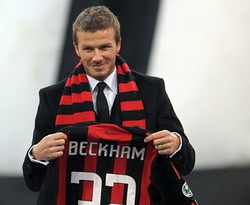
Beckham: Good, But Not That Good

On Monday’s Fox Football Fone-In show in the US, regular Milan-based guest Hyder Jawal gave a refreshing take on David Beckham’s tenure in Serie A by describing it as no more than ordinary. Having watched Beckham’s six games in their entirety rather than relying on the viewpoints peddled by the Associated Press, I am fully in agreement.

Beckham has surprised everyone – himself included – with his form since debuting on January 11. He has slotted comfortably into the Rossoneri’s star-studded line-up despite the obvious problems for foreign players arriving in a new country, adapting to a new environment, and overcoming a language barrier.

While most observers envisaged the on-loan Los Angeles Galaxy man being little more than a bit-part player during his three-month stay, a window of opportunity opened when Gennaro Gattuso tore a cruciate ligament last December. Ancelotti entrusted Beckham with a starting berth at Roma, but the formidable Brazilian duo of Kaká and Alexandre Pato stole the show – the latter scoring twice in a 2-2 draw. Beckham performed conservatively by keeping his passes short, simple, and unspectacular.

The pattern has continued. Beckham’s play remains cautious, dictated by a fear of conceding possession. The majority of his passes remain routine, shifting possession inside to Andrea Pirlo or wide to the rampaging right-back Gianluca Zambrotta. Genoa goalkeeper Rubinho was caught out by a wily free-kick in the 1-1 draw on January 28, but his set pieces and deliveries from wide areas have largely been disappointing. Pato and Kaká have many outstanding qualities – rising above central defenders to attack crosses is not one of them.

The Genoa game came three days after Beckham notched his first goal having been given the freedom of Emilia-Romagna to top off a 4-1 win against a bedraggled ten-man Bologna. It marked his best performance to date although he wilted in the final thirty minutes as the Grifone pressed for a deserved equaliser.

Beckham’s army of sycophants turned up the volume after his two “assists” in the 3-0 win at Lazio on February 1. The first pass for Pato – a square ball across the penalty box after both players had been left in acres of space by Lazio’s faltering offside trap – would have been made by any player in the Milan squad. The second – a routine set play hoisted towards the back post – owed everything to the tenacity of Massimo Ambrosini as the Italian midfielder evaded his marker to power a header beyond Fernando Muslera. Otherwise it was another inconspicuous afternoon for the Englishman.

Overall, Beckham has done okay. He certainly has not looked out of place; nor though has he resembled the second coming of Maradona circa 1986 as some would have you believe. For all the plaudits being showered upon him, he has performed no better than fellow midfielders Pirlo, Clarence Seedorf, or the scandalously under-rated vice-captain Ambrosini.

On The Plus Side……

Should Milan and Beckham, as seems increasingly likely, obtain their wish in prizing the player away from his five-year contract with Major League Soccer:

1) MLS fans will no longer have to stomach the insipid, lifeless performances served up on a weekly basis by a patronising and plainly-uninterested $50m-a-year man.

2) The millions who brazenly champion England’s “best league in the world” might take a greater interest in Serie A, discovering in the process that Calcio offers infinitely greater aesthetic talent than the dire fare served up on a weekly basis by the likes of Bolton, Blackburn, Middlesbrough, Stoke…..

Sunday, February 1, 2009

Soccer Back on the Horizon

This article first appeared in RedMatchday Magazine, Aberdeen Football Club's award-winning publication, on January 24, 2009.

The countdown to the Major League Soccer kick-off on March 19 began in earnest last week with the 2009 SuperDraft held in St. Louis, Missouri. Previous first picks have included Brian McBride (Columbus Crew’s choice in the league’s first draft in 1996), the then 14-year-old striker Freddy Adu (2004 – D.C. United), and Rangers midfielder Maurice Edu (2007 – Toronto); three players who crossed over to Europe to further their careers. This year’s first choice takes the opposing route as Londoner Steve Zakuani joins Seattle Sounders.

As the league’s newest franchise, Seattle were granted first pick to help with their squad expansion. They have already pulled off a major coup by landing last season’s championship-winning head coach Sigi Schmid from Columbus, as well as signing former Premiership duo Kasey Keller and Freddie Ljungberg. Such additions give kudos to the commitment shown by an ownership group including Microsoft co-founder Paul Allen and comedian Drew Carey. The Emerald City has responded enthusiastically with 19,000 season tickets already sold – the highest number of any MLS team.

Zakuani’s journey is one that he thinks will become increasingly popular with youngsters being overlooked by England’s top clubs. Speaking to Fox Soccer Channel after his selection, he said: “I think you will see it (English players enrolling in American soccer scholarships) more and more as MLS gets more exposure and a lot of college kids make it into the league. In England, you can’t play soccer and study at the same time. This is a unique system that still gives you a chance to go professional afterwards.”

The Congo-born striker moved to the UK at an early age whereupon his prodigious talent was spotted by Arsenal scouts. After representing the Gunners at various youth team levels but failing to earn a professional contract, Zakuani accepted a soccer scholarship at University of Akron, Ohio. He terrorised defences during his two years of college play with his threatening combination of height, explosive pace, willingness to run at defences, and coolness in front of goal. He scored 43 goals in 44 matches in total – a feat which caught the attention of scouts from nearby Columbus, a two-hour drive from Akron, and one that the departed head coach Schmid remembered on draft day. Schmid likens his new protégé’s talents to those of former Rangers player Brian Laudrup.

Zakuani, whose elder sibling Gabriel is currently on loan from Fulham to Peterborough United, is confident that he can make an early impact in MLS. Speaking at the Draft, he said: “I’m ready. I’m going to work hard, catch up to the level of play, and hopefully contribute right away. I think (Seattle) is probably the best team to go to because everyone is new. We’re all going to come in and fight for starting spots.”

Although teams receive four draft picks, one in each of four rounds of selections, those picks are frequently traded away as makeweights in other transfer deals. Mo Johnston, Director of Soccer for Toronto, was the busiest man in the floor during the first round as the Canadians held second, fourth, and thirteenth choices. Johnston sealed a prime acquisition last month by tempting Dwayne De Rosario back to his hometown after a trophy-laden career with San Jose Earthquakes and Houston Dynamo.

Houston adopted the most sagacious strategy in selecting Marcus Tracy with their lowly 56th pick. The Wake Forest University striker pipped Zakuani to the 2008 college Player of the Year award, but he decided to sign a contract with Danish champions Aalborg rather than join the draft. By selecting Tracy nonetheless, Houston retain his rights for two years and could land the player if an unsuccessful European stint hastens his return home.

Ladies Get In On The Act

The first draft for the newly-formed Women’s Professional Soccer league (WPS) also took place in St. Louis last week. Anyone who witnessed the US defeating Brazil in last summer’s Olympic Final will be aware that the quality of women’s football has improved dramatically in recent years. The gold-winning Americans will be joined by a wealth of international talent as star players from the national teams of Australia, Brazil, China, England, France, Germany, Japan, and Sweden have been quick to sign up, much to the chagrin of Europe’s top leagues.

Having seen the Women’s United Soccer Association accumulate $100m losses in its brief three-year existence prior to folding in 2003, WPS Commissioner Tonya Antonucci advocates a slow and steady growth this time around. Common ownerships with MLS franchises and the use of shared stadia are highly desired to take advantage of economic synergies. Seven teams will compete in the inaugural competition beginning on March 29 with three further sides joining in 2010. Fox Soccer Channel is on board to carry a weekly live game and the channel has already started its advertising campaign with US internationals Heather Mitts and Hope Solo promoting “The Beautiful Game”.

The league’s biggest attraction will undoubtedly be Marta, the outrageously talented Brazilian forward who has monopolised the FIFA Women’s World Player of the Year award since 2006. Marta leaves behind the Swedish league to join Los Angeles Sol; one franchise already sharing ownership and a stadium with an MLS team (L.A. Galaxy).

Antonucci hopes for initial attendances in the range of 4,000 to 6,000, but regardless of the improved quality on offer it is difficult to envisage figures rising above that level. The continued gentrification of the sport makes stadia increasingly family-friendly and elevated numbers of women and families in attendance at men’s games can only serve to reduce the consumer base for WPS. Given the choice between watching the men’s or women’s game, it is hard to imagine too many fans shelling out for the latter.